Project overview
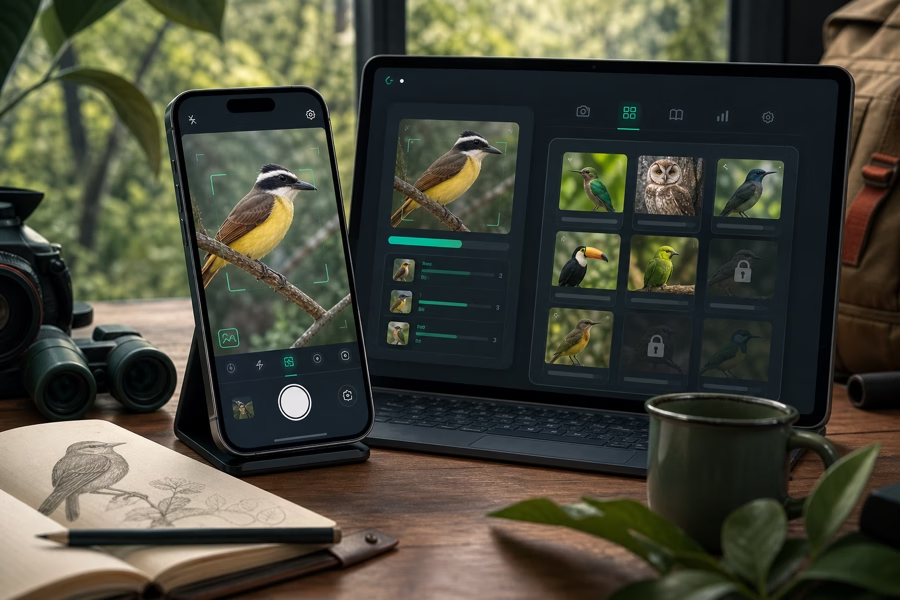
BirdDex AI is a browser-based bird identification and collection app designed as a playful, web-first field device. The idea started as an exploration of visual ML tools such as Google Teachable Machine, then evolved into a controlled TensorFlow pipeline with dataset curation, model training, evaluation, TensorFlow.js export, and browser integration. Users capture a bird with the in-app camera, run model inference directly in the browser, confirm the suggested species or mark it as unknown, and unlock species entries in a personal BirdDex collection.
Challenge
Create an MVP that feels polished and collectible while proving the full AI loop in a short build cycle: product framing, dataset curation, model training, TensorFlow.js export, browser inference, capture confirmation, species unlocking, and historical capture review. The scope was intentionally reduced to 10 popular Brazilian birds so the model could be trained, validated, and shipped quickly without pretending to solve a broad biological classification problem on day one.
Solution
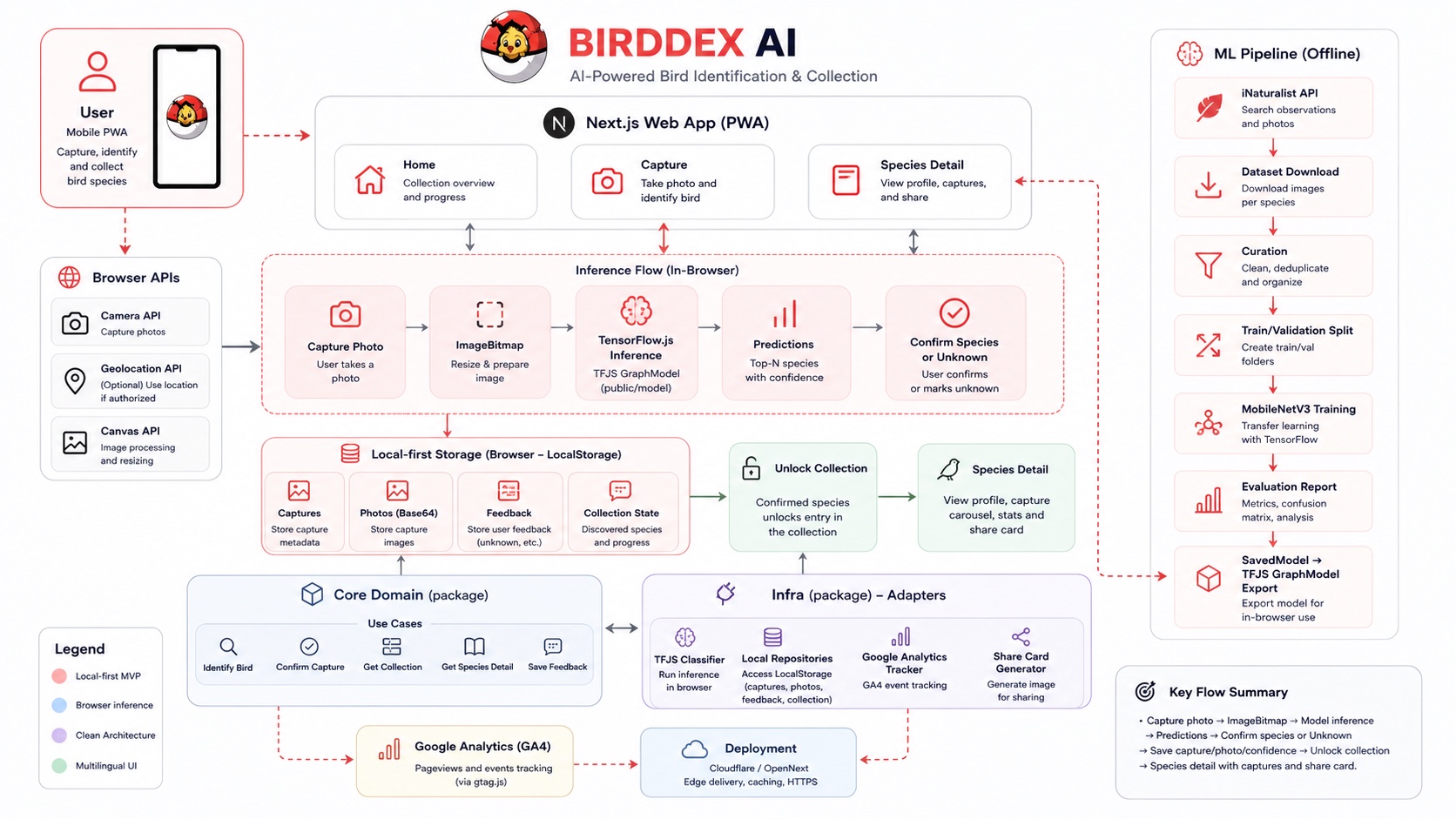
Built a layered architecture separating domain rules, application use cases, infrastructure adapters, and the Next.js UI. TensorFlow.js inference runs directly in the browser, avoiding an inference API to reduce cost, preserve privacy, simplify the MVP architecture, and keep the experience PWA-friendly. The ML pipeline curates iNaturalist bird data, prepares balanced train and validation splits, trains a MobileNetV3-based classifier, evaluates it on 400 validation images across 10 classes, reaches roughly 74.75% validation accuracy in the first iteration, exports TensorFlow.js artifacts, and publishes the required files into the web app. With a defined process and strong prompts, a project like this can move from concept to working demo in a day without skipping engineering discipline.
Related articles
This project is a practical example of AI-assisted development with process, prompt engineering discipline, and real ML Engineering: the model was trained, evaluated, exported, and wired into the browser experience.
The problem isn't AI. It's using AI without process.
How AI-assisted development can deliver fast results when it is guided by architecture, checkpoints, validation, and a clear engineering process.
The Ultimate Guide to Prompt Engineering
The prompt engineering playbook behind turning intent into structured plans, implementation loops, reviews, and usable software instead of vague AI output.
Tech Stack
- Next.js
- TensorFlow.js
- Computer Vision
- ML Engineering
- Clean Architecture
- PWA
- i18n
- ML Pipeline
Technical scope
- Web-first PWA with in-app camera capture and standalone app behavior
- ML Engineering pipeline with iNaturalist curation, MobileNetV3 training, validation, and TensorFlow.js export
- Local-first BirdDex collection with discovered, undiscovered, unknown, feedback, and capture history states
- Browser inference trade-off optimized for privacy, low operating cost, PWA delivery, and MVP speed